
Sex Offender Checks in Hampton County
The South Carolina Sex Offender Registry Tool, known as SORT, is the main public channel for Hampton County. SLED manages the tool, while county sheriffs keep registration data for people who live, own real property, work, or attend school in their counties. A search can begin by name or geography after the user accepts the conditions and passes the verification gate. SORT also offers community notification registration. Its data can change fast, so the date of review matters.
A careful Hampton County sex offender check uses more than a name match. Compare the current photo, aliases, physical description, conviction details, and address on file. An address or status may have been reported but not yet verified. Inclusion on SORT follows South Carolina law; it does not state that a listed person poses a current threat. For a wider check involving other states, add the federal national portal, but retain SORT for South Carolina location searches.
Hampton County SORT Conditions Gate
SORT does not open straight into a result list. A Hampton County visitor must first choose “I agree,” enter the displayed verification code, and select Continue. The gate places SLED's use terms before the public data and reduces automated access. If the code is hard to use, follow the accessibility route offered on the official screen rather than trying to bypass it.
The official SORT entry screen shows how Hampton County registry access begins.
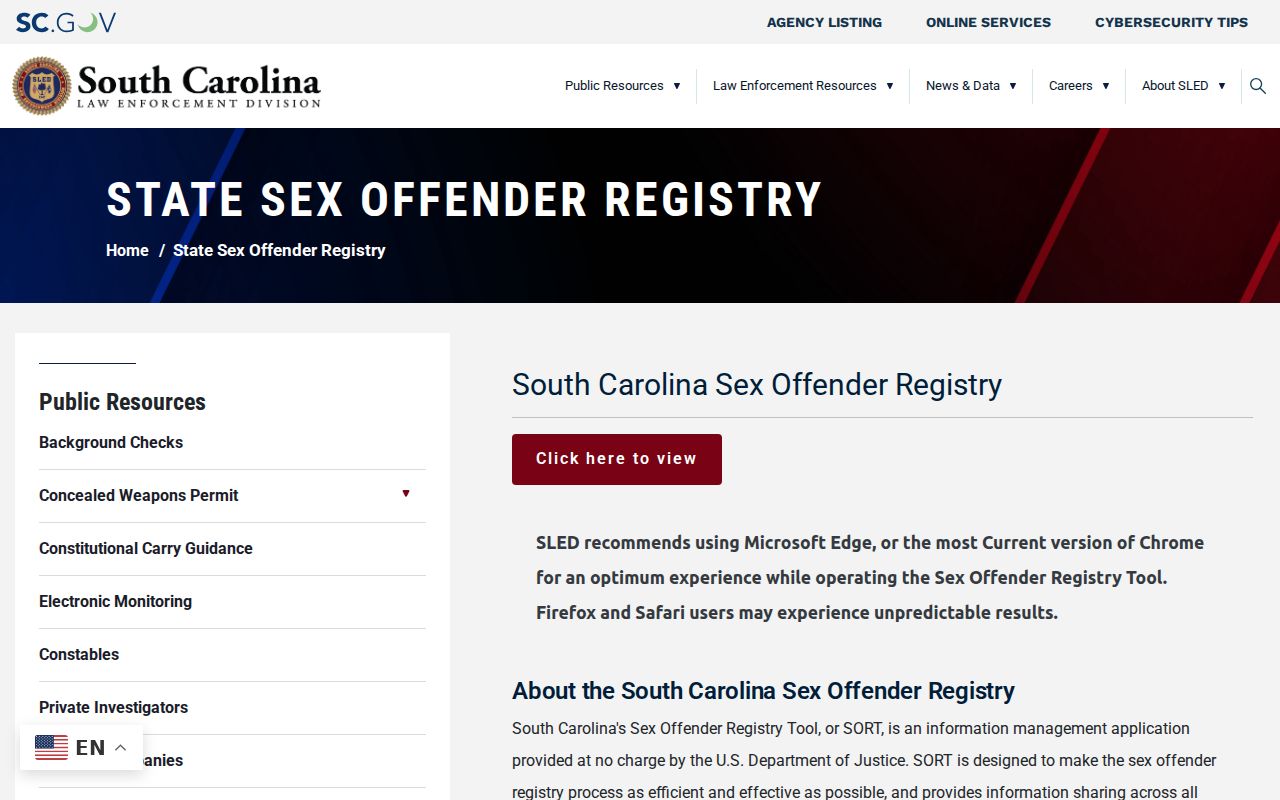
This gate is why saved result links may not replace a fresh Hampton County search session. Return to the entry page, accept the conditions, and complete the current verification step.
How to Search the South Carolina Sex Offender Registry Tool (SORT)
Choose the Hampton County search route that fits the fact already known. Name Search works best when a first and last name can be checked against profile identifiers. Geographic Search is the better Hampton County route for an address-based review. Community Notifications is a separate signup workflow, not a one-time result screen. Exact map radii and post-CAPTCHA choices can change, so only use options displayed during the live session.
- Open SORT, read the conditions, choose “I agree,” enter the verification code, and select Continue.
- Choose Name Search or Geographic Search. Use the narrowest reliable information without assuming that one matching name proves identity.
- Review the Hampton County result list, then compare photographs, aliases, physical traits, conviction data, and the address shown on each candidate profile.
- For ongoing local notice, choose Community Notifications, complete its registration fields, and accept the separate agreement terms.
| Control or Field | Type | Required | Use |
|---|---|---|---|
| I agree / I do not agree | Buttons | Yes | Accept or reject registry conditions |
| Verification code | Text / CAPTCHA | Yes | Enter the shown code, then Continue |
| Geographic Search | Mode | Optional route | Search by location after the gate |
| Name Search | Mode | Optional route | Search by a registrant's name |
| Community Notifications | Mode | Optional route | Register for alert notices |
Hampton County Registry and NSOPW
The National Sex Offender Public Website combines public data from participating jurisdictions. Its form supports a first and last name together or as many as five ZIP codes. County, city or town, and jurisdiction choices can narrow the request. That makes NSOPW useful when a person may have records beyond Hampton County or across a state line.
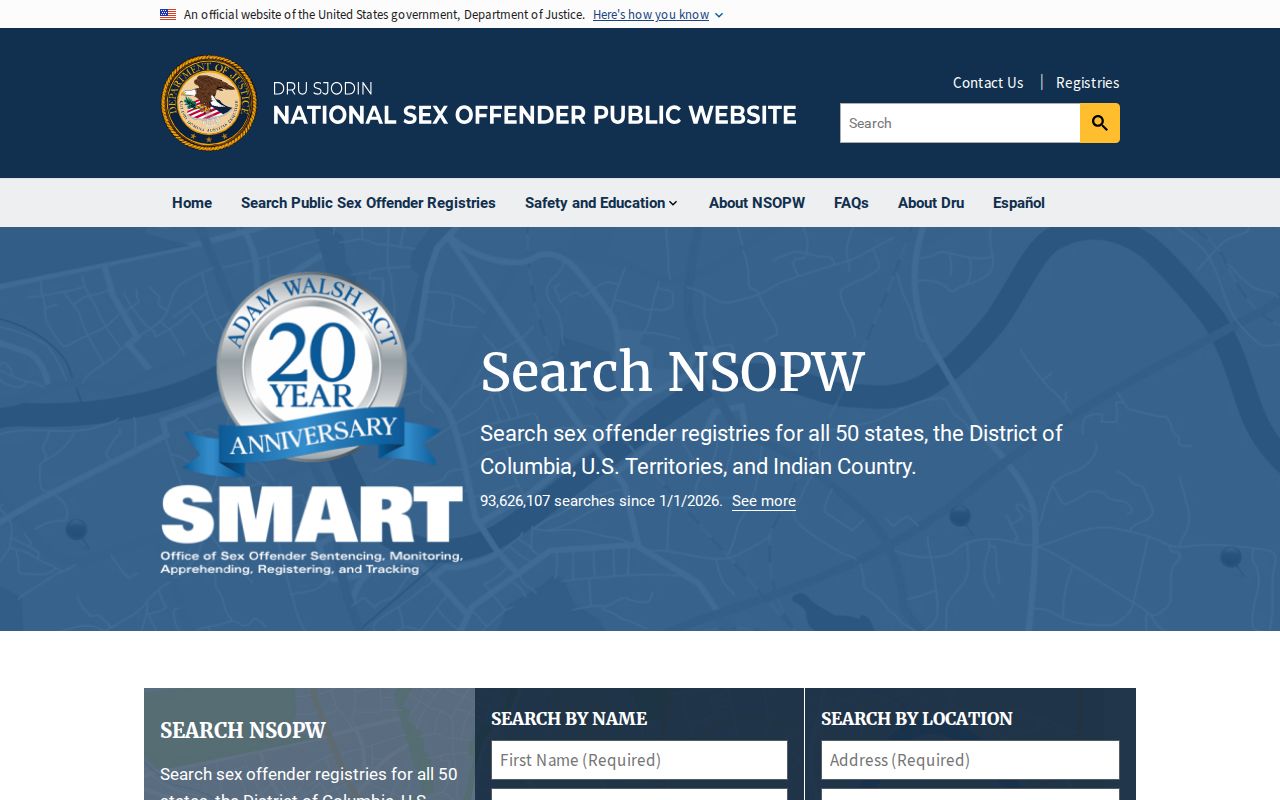
The national screen adds reach, but DOJ says South Carolina does not send geographic coordinates to NSOPW. Radius searching therefore does not cover this state. Use SORT's Geographic Search for a Hampton County address or neighborhood, and use NSOPW as the cross-state layer.
Note: A national no-result screen does not replace the South Carolina geographic search when location, rather than a known name, drives the check.
Inside a Registry Profile
A Hampton County public registry profile contains a focused set of facts authorized by South Carolina law. SLED advertises photos from more than one point in time, a visual residence map, aliases, and sexually related conviction offenses. Section 23-3-490 also authorizes public identifying traits, date of birth, the home address on file, the qualifying offense, its conviction date and place, and a current photograph.
| Name and Aliases | The public full name plus known aliases authorized for release. |
|---|---|
| Photos and Description | A current photograph, possible earlier photographs, and identifying physical characteristics. |
| Registered Address | The home address on file and a visual residence map, subject to reporting and verification timing. |
| Qualifying Offense | The sexually related conviction offense plus conviction date and place. |
| Registration Status | Public status information maintained through SLED and the responsible sheriff. |
| Not Assured Public | Data collected for registration, such as some vehicle or internet identifiers, is not necessarily shown on every public profile. |
The broader Hampton County registration protocol collects residence, work, vehicles, internet identifiers, school or campus ties, and other data. Collection by law enforcement does not mean every field is public. Read the actual Hampton County profile instead of assuming the database displays the full registration file.
Hampton County Registration Counter
Local registration runs through the Hampton County Sheriff's Law Enforcement Center at 411 Cemetery Road in Varnville. The sheriff's office lists 803-914-2200, fax 803-914-2213, sheriff@hamptoncountysc.org, and weekday hours from 8:00 a.m. to 5:00 p.m. The law requires sheriffs to set registration times, but Hampton County does not publish a distinct registry appointment calendar or local fee. Call before visiting.
Hampton County Sheriff
Law Enforcement Center
411 Cemetery Road
Varnville, SC 29944
803-914-2200
Monday through Friday, 8:00 a.m. to 5:00 p.m.
Registration applies in each county where a person resides, owns real property, works, or attends school. A move within Hampton County requires written notice within three business days. Moving to another South Carolina county requires registration there and notice to the former sheriff within the same period. A temporary residence includes ten or more consecutive days.
South Carolina Registration Levels and Requirements
South Carolina ties Hampton County verification and possible termination routes to tier or status. Registration is generally for life unless the person qualifies for the statutory administrative or court process. For multiple offenses, the highest tier controls. Verification is distinct from removal: checking in as required does not by itself shorten the registration period.
| Tier or Status | Verification and Duration | Earliest Termination Route |
|---|---|---|
| Tier I | Generally twice yearly, in the birth month and six months later; lifetime unless terminated | SLED application after the relevant 15-year period, if all conditions are met |
| Tier II | Generally twice yearly; lifetime unless terminated | SLED application after the relevant 25-year period and required conditions |
| Tier III | Verification every 90 days; lifetime unless court relief applies | Adult route generally requires a court motion after the relevant 30-year period |
| Sexually violent predator | Sheriff verification and photograph every 90 days | Specialized statutory and court rules apply |
Tier I and II applicants use SLED's process. Adult Tier III relief generally goes through court. Conditions include treatment completion, no failure-to-register conviction in the prior ten years, and no later qualifying sexual offense. SLED lists a $250 fee, two recent FD-258 fingerprint sets, disposition or sentencing records, and proof of treatment. A complete application can take up to 120 days for SLED review; a denial may be revisited after five years.
Hampton County Address Distance Rules
The 1,000-foot residence rule in Section 23-3-535 is offense-specific. It measures from property lines near a school, daycare, children's recreational facility, park, or playground for covered convictions. It does not apply in the same way to every person on the Hampton County registry, and the law contains exceptions. Section 23-3-465 separately addresses housing on a public institution's campus.
The South Carolina registry statutes show the difference between public profile data, registration duties, residence restrictions, and termination procedures.
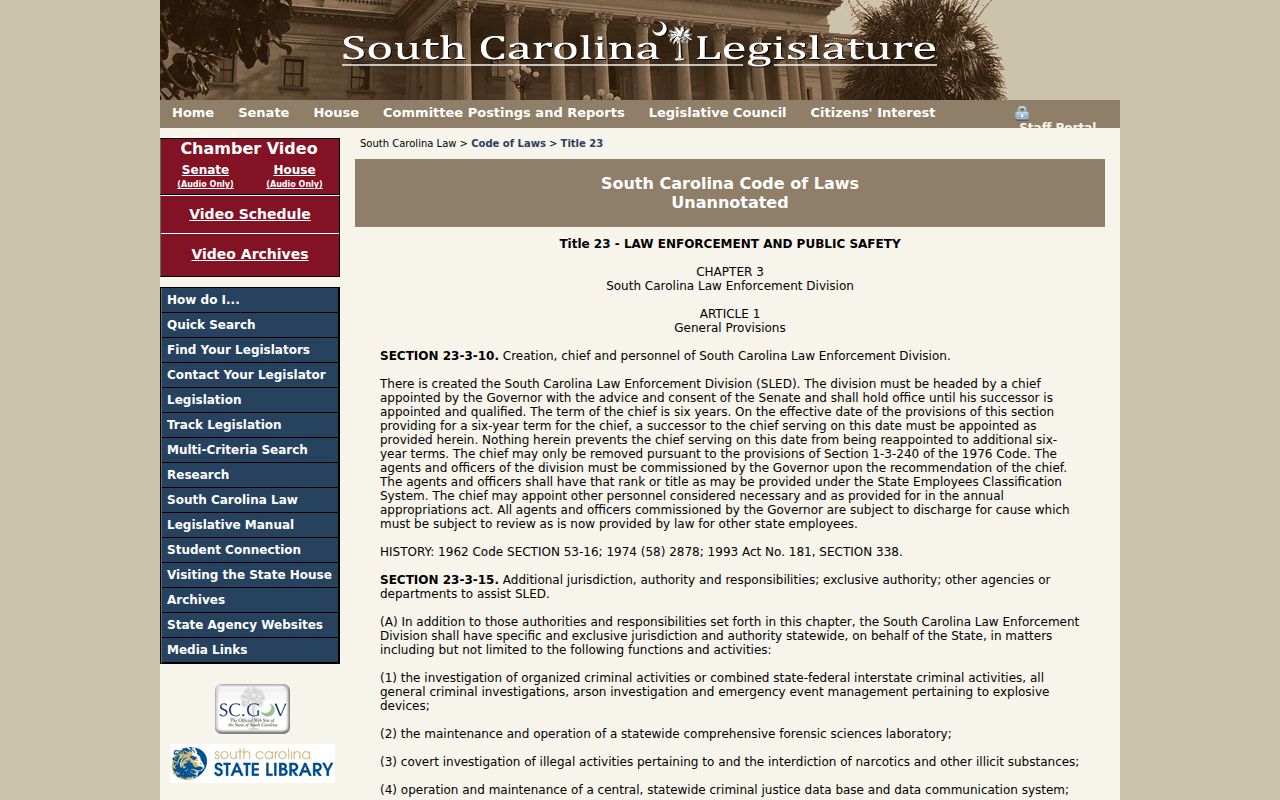
The statute image is a prompt to check the offense and rule text, not to draw a boundary from memory. SORT's map can support awareness, but only the governing facts and applicable exceptions resolve a legal restriction.
Reporting Hampton County Registry Noncompliance
A stale-looking Hampton County address is not proof of a crime. Registry data may change before verification reaches the public screen. If facts suggest missed registration or another compliance issue, report the concern to the Hampton County Sheriff at 803-914-2200. Nonemergency dispatch is 803-943-9261. Call 911 only for an emergency.
Questions about an incorrect SORT entry go to the SLED Sex Offender Registry Unit at 803-896-2601, fax 803-896-2311, or sor@sled.sc.gov. Mail may be sent to P.O. Box 21398, Columbia, SC 29210. Keep suspected noncompliance separate from a data correction: the sheriff handles local compliance, while SLED handles errors in the state registry display.
Community Notification and Lawful Use
Community Notifications in SORT can provide an ongoing Hampton County awareness channel after the terms are accepted and registration fields are complete. Use alerts to support personal and family safety. Confirm a profile through current official data before acting, especially when an address or status may still await verification. The registry's role is notice under the law, not punishment by members of the public.
Misuse is a crime: Under S.C. Code §23-3-510, using registry data to commit an offense can add up to $1,000 and six months to a misdemeanor maximum or up to five years to a felony maximum. Do not harass, threaten, injure, or commit an offense against a registrant or anyone at a reported address.
Registry information should not be stretched into facts it does not claim. A listed offense and registration status are not a current risk score. For broader Hampton County record context, the county criminal history overview explains why court, arrest, custody, and SLED records answer different questions.