
Checking Criminal History in Hampton
Begin at city altitude. The record creator is the best first stop: Hampton Police for a police report, Municipal Court for a town citation or summary case, and Hampton County only after the event moves into county custody or prosecution. There is no published Hampton police report portal, online blotter, or municipal case-search form. Phone and counter access therefore matter.
- Contact Hampton Police with the incident date, location, report number if known, and enough contact information to answer the request.
- Ask for the identified incident or arrest report. If no routine channel fits, make a narrow town FOIA request for an existing record.
- Call Hampton Municipal Court for a city citation, ordinance case, traffic matter, or other municipal file.
- For an arrest, call Hampton County Detention Center to check custody or booking, then use the county court channel if prosecution moved to General Sessions.
- Use SLED CATCH only when the need extends to a statewide name-based repository result, not as a substitute for the local file.
Each Hampton result answers a different question. A Hampton police narrative documents the reported event and response. A court file tracks a filed charge and outcome. A booking record follows one custody intake. SLED's record depends on fingerprint and disposition submissions. Compare the right fields instead of forcing them into one label.
Requesting Hampton Police Reports
The Hampton Police Department is at 608 First Street West, Hampton, SC 29924. Its main number is 803-943-2421, fax is 803-943-0494, and the published email is BDrawdy@hamptonsc.gov. Office hours run from 8:30 a.m. to 5:00 p.m. Nonemergency dispatch is 803-943-9261.
No Hampton request form, fixed report fee, public portal, or blotter was found. Give Hampton staff the incident date, location, report or case number if known, and requester contact details. Ask whether the record is ready and which release limits apply. If routine access does not resolve the request, South Carolina FOIA provides a fallback for an identified existing record. A narrow request is more useful than asking staff to compile a person's full history.
Hampton Police Department
608 First Street West
Hampton, SC 29924
803-943-2421
Monday through Friday, 8:30 a.m. to 5:00 p.m.
Hampton Police Department Records
Hampton Police creates the city-level incident and arrest paperwork. That file can contain the time and place of the event, the reporting parties, initial offense information, the responding officer's work, and a report number. Release may be narrowed when an investigation is active, privacy is at stake, a confidential source could be exposed, investigative methods could be revealed, or safety could be put at risk.
Do not treat the first Hampton police allegation as the last court result. The prosecutor may alter a charge, a court may dismiss it, or the case may resolve under a different count. A city report also does not replace the municipal docket, county booking sheet, or SLED history. When the exact outcome matters, identify the court that received the charge and ask its clerk for the case record.
Note: Juvenile material and victim-sensitive records do not follow the ordinary adult public-record path and may be withheld or redacted.
Hampton Safety Programs and Fingerprints
Hampton Police lists neighborhood crime-watch organization, property checks, elderly-safety checks, community classes, narcotics enforcement, mutual aid, and fingerprint processing among its services. These programs explain some of the calls, contacts, and administrative records that may exist outside a filed criminal case. They do not create a public history screen.
Fingerprint processing is also distinct from a police report request. South Carolina's central criminal-history repository is kept by SLED, not the town. Someone reviewing their own record should confirm the purpose, card type, appointment needs, and current cost before going to the Hampton counter. A local fingerprint capture is an identity step; it is not itself the resulting state or federal record.
Hampton Arrests and Bookings
Hampton does not publish a city jail. When Hampton Police takes a person into custody, the town report remains with the police department while booking occurs through Hampton County Detention Center in Varnville. Detention staff create a separate intake record, take fingerprints, and track custody, property, bond, release, or transfer events. Call 803-914-2223 to ask whether someone is currently held and which agency made the booking.
A current-custody answer is not a full arrest archive. Release may remove a person from a live view, and a recent arrest can predate any court filing. If a charge stays at city summary level, ask Hampton Municipal Court. If it becomes a higher prosecution, search the Hampton County Public Index and contact the Clerk of Court for documents that are not imaged. The full county booking and arrest workflow appears in the Hampton County arrest lookup.
From Hampton Arrest to County Booking
A single Hampton arrest can leave four trails. Police make the incident and arrest record. County detention makes the booking and fingerprint record. A magistrate creates bond-hearing material. The proper court then creates a case if a charge is filed. The paths may start close together but update on different schedules.
Local arrest flow: Hampton Police › Hampton County Detention Center › Municipal Court or General Sessions › SLED
Fingerprints are the key link to SLED's Computerized Criminal History repository. A direct indictment or amended charge may be missing from the state file if new prints do not support the update. Court outcomes can also lag or fail to match. That is why a Hampton police report may exist when CATCH does not show the event, or a state entry may lack the final court outcome.
Municipal Court Records in Hampton
Hampton Municipal Court shares the police department's 608 First Street West address. Clerk Christy Allen can be reached at Courtclerk@hamptonsc.gov or 803-943-9364. Clerk hours are Monday through Friday from 9:00 a.m. to 5:00 p.m. Court meets on the first and second Mondays at 5:30 p.m., except on holidays. Judges William “Bill” Hazel and Loretta Beckett are listed by the town.
| Court | Hampton Municipal Court at 608 First Street West |
|---|---|
| Local Case Scope | City traffic, ordinance, and lower-level criminal matters within municipal authority |
| Record Access | Clerk phone, email, or counter; no public municipal search form was found |
| Useful Identifiers | Name, citation or case reference, charge, and court date when known |
| Session Schedule | First and second Mondays at 5:30 p.m., except holidays |
| Payment System | PayThatTicket is a transaction channel, not a public case lookup |
The official Hampton Municipal Court page publishes the clerk and session details.
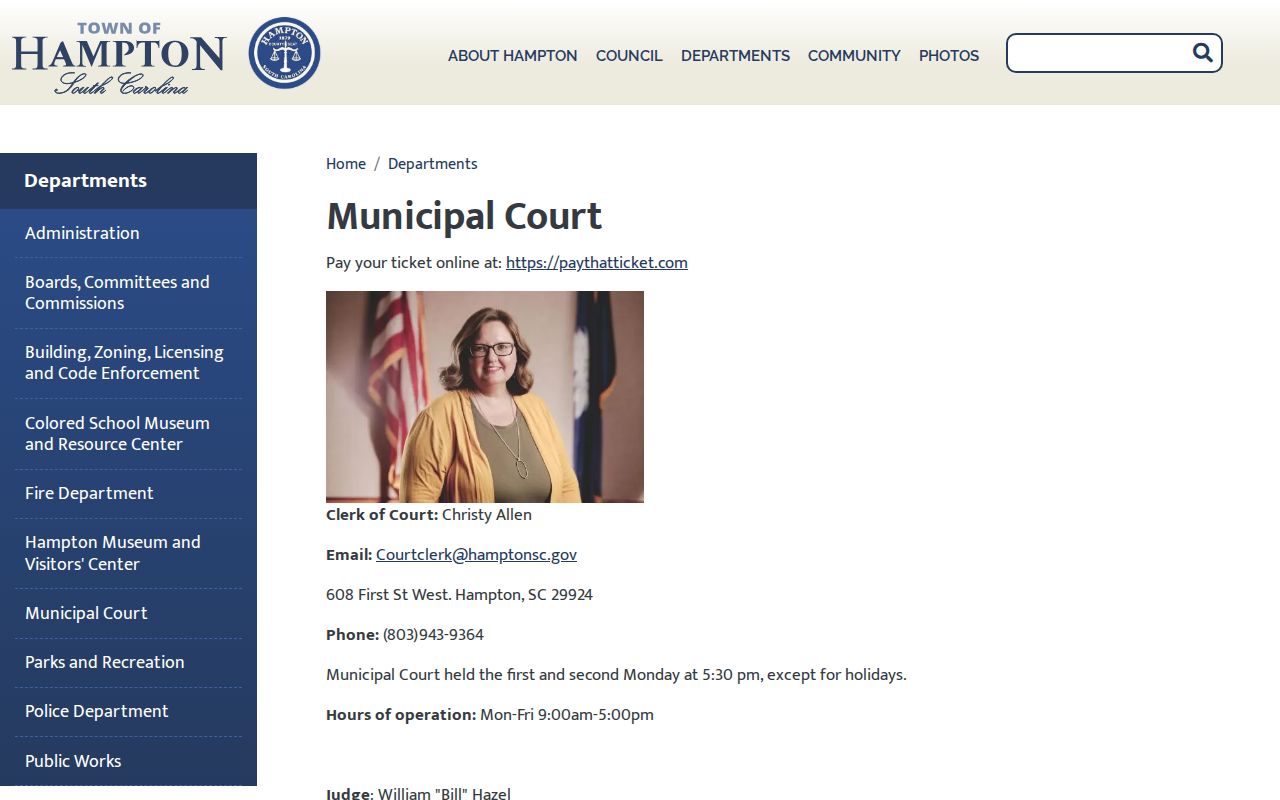
The court screen is the right source for local contacts and payment access, but the clerk remains the route for Hampton case records.
Monday Court Sessions in Hampton
The published first-and-second-Monday schedule helps distinguish a court date from counter hours. The clerk's office is available on weekdays, while the court session begins at 5:30 p.m. on its set Mondays unless a holiday changes the calendar. Call the clerk before relying on a date, especially when the question involves a continuance, missed appearance, or an older record.
A docket can hold the citation or case number, filed charge, events, plea or trial result, disposition, and financial entries. Not every Hampton municipal case must appear in the county Public Index because only some municipal courts participate in that system. An empty county search is therefore not proof that the Municipal Court has no case.
Hampton Payment Is Not Case Search
PayThatTicket processes a citation payment. It does not function as a public Hampton criminal records database. A transaction screen may ask for a citation or reference and payment information, then show a service fee during the purchase. Those fields help apply money to an identified matter; they do not expose the full docket or prove the final outcome.
| Hampton Channel | Best Use | Key Limit |
|---|---|---|
| Police counter or phone | Identified incident or arrest report | No public report portal or blotter found |
| Municipal Court clerk | City case status, docket, and copies | No public city case-search form found |
| PayThatTicket | Payment for an identified citation | Transaction only, not record search |
| County Public Index | Filed county court cases | Some municipal matters may be absent |
When a receipt is the goal, use the payment route. When the charge, court events, or disposition are the goal, contact the court clerk. Keeping those tasks separate prevents a payment confirmation from being mistaken for a Hampton case history.
Where Hampton Records Go
City records do not all move upward in the same way. A Hampton Police report stays with the department even if the arrest also creates county custody and court files. A municipal matter remains with Hampton Municipal Court. Felony and higher criminal proceedings go to General Sessions in the Fourteenth Judicial Circuit. Reported fingerprints and court dispositions may later feed SLED's state repository.
Record flow: Hampton Police Department › Hampton County Courts › South Carolina Law Enforcement Division
For recent activity, start with the police and detention contacts because court and state systems may not yet show it. For a filed outcome, use the responsible court. For a statewide name-based result, use SLED CATCH and recognize name-match and reporting gaps. The broader Hampton County criminal history route covers those county and state channels in depth.
Hampton Records Lost to Fire
Hampton incorporated on December 23, 1879, as Hampton Courthouse. Donated land was described for both the town and courthouse. The first Town Hall was built in 1952, but fire destroyed earlier municipal records. That loss is a real limit for local historical research, not a sign that a modern search tool is malfunctioning.
The town's official history supplies the local timeline and municipal-building context.
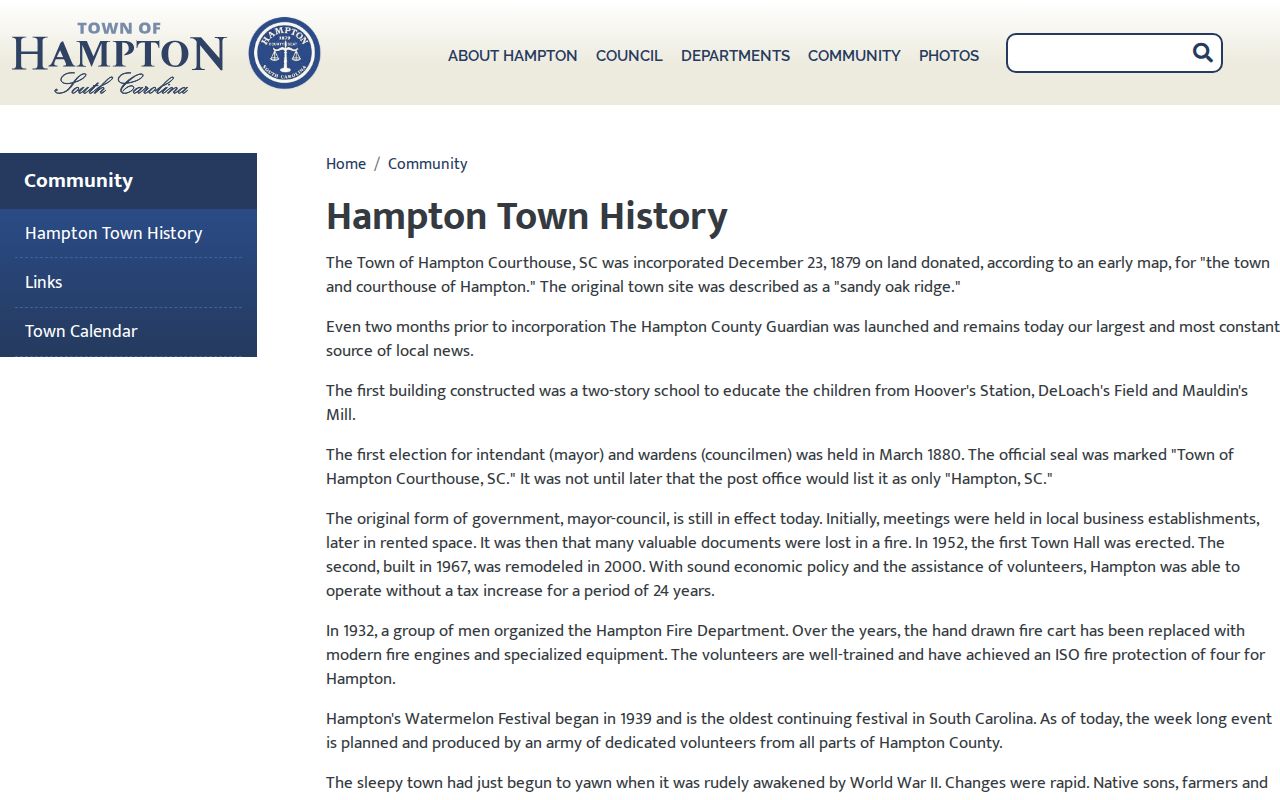
The historic source helps set expectations for genealogy and old town-record work. Current police and municipal files use the active department and court channels, while surviving older material may require a more focused inquiry about what remains.
Hampton's Watermelon Festival began in 1939 and is described by the town as South Carolina's oldest continuing festival. That civic timeline can help date photographs, news, and family records, but it should not be used to infer that a missing justice record once existed.
Public Access Rules in Hampton
South Carolina FOIA broadly defines public records, yet release limits still protect active enforcement, fair-trial rights, personal privacy, confidential sources, investigative methods, and safety. Hampton Police may redact or withhold a supported part of a report rather than turn every request into unrestricted access. FOIA also does not require the town to create a new analysis or compile a custom history.
Court records have judicial access rules and clerk practices in addition to executive-branch FOIA. Sealed, expunged, and juvenile material must not be treated as public just because it may once have appeared in a system. Request the identified Hampton record from its custodian and ask for the legal basis when access is restricted.
Key Statutes:
South Carolina Freedom of Information Act defines public records, sets response and production rules, and permits specific law-enforcement and privacy exemptions.
S.C. Code Title 23, Chapter 3 governs SLED criminal-history dissemination and related state records.
S.C. Code Title 17, Chapter 22 controls many expungement paths and the destruction of qualifying records.
A denial should identify the applicable rule rather than merely calling the whole file confidential. Start with a precise request for an incident report, named docket, or other existing item. That gives Hampton staff a clear record to locate and a clear release question to decide.